If you have been baking for a while, you have probably noticed that recipes don’t always agree with each other. Some tell you to use 2 cups of flour. Others say 240 grams. A few even list both. And if you’re like most home bakers, you’ve probably just grabbed whatever measuring cup was sitting on the counter and hoped for the best.
But here’s the thing — that small choice between a cup and a scale might actually be the reason your cakes sometimes turn out dry, your cookies spread too much, or your bread refuses to rise the way it should.
Let’s talk about this honestly, because it’s one of those topics that sounds boring until the day your baking goes wrong for no obvious reason.
Where Did Cup Measurements Even Come From?
Cup measurements have been around for over a century. They were popularised in the United States as a way to make recipes more accessible to everyday home cooks who didn’t own scales. The idea was simple — use the same cup for everything, and cooking becomes easier for everyone.
And for a long time, that worked reasonably well. Most American and old-school Indian recipe books still follow this system. If you grew up watching your mother or grandmother bake, chances are she used a katori or a standard measuring cup and everything still came out beautifully.
So there’s nothing wrong with cups. The issue is a bit more nuanced than that.
The Real Problem With Cups
The problem with cup measurements isn’t the cup itself. It’s the ingredient you’re putting in it.
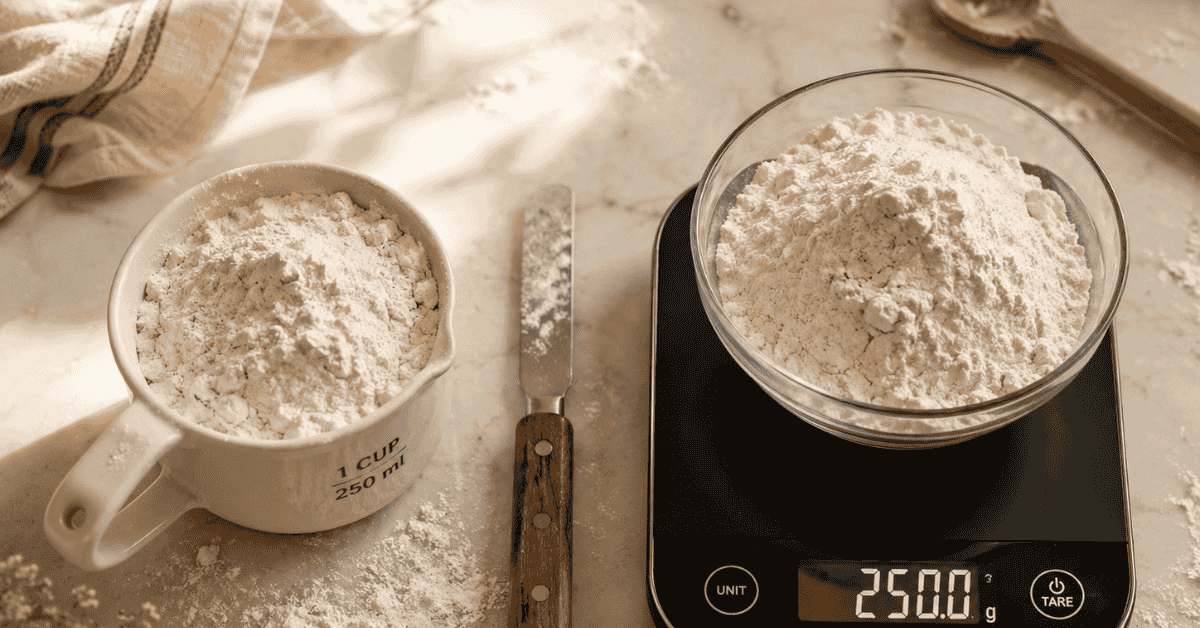
Think about flour for a moment. When you scoop flour directly from the bag into a measuring cup, you compact it. The cup ends up holding maybe 20 to 30 grams more flour than the recipe actually intended. That extra flour — which you can’t even see — can make your cake dense, your muffins dry, and your pancakes stiff.
Now compare that to someone who fluffs the flour first, then spoons it gently into the cup and levels it off. That person’s cup has significantly less flour than yours does. You’re both following the same recipe, but your results will be completely different.
This variation doesn’t just happen with flour. Brown sugar can weigh anywhere between 180 grams and 240 grams per cup depending on how tightly it’s packed. Cocoa powder is notoriously inconsistent. Even oats can vary quite a bit depending on whether they settle or stay fluffy.
This is why two bakers can follow the exact same recipe and get noticeably different results. It’s not talent. It’s not luck. It’s just the inconsistency that comes with volume-based measuring.
Why Grams Are More Reliable
When you weigh ingredients in grams, all of that inconsistency disappears. 200 grams of flour is 200 grams of flour — whether it’s been sitting in the bag for a week, whether the weather is humid, whether you scooped it or spooned it. The number doesn’t lie.
This is why professional pastry kitchens, bakeries, and serious baking courses almost always use weight measurements. When you’re making 50 croissants or 200 cookies for a catering order, you cannot afford that kind of variation. Every batch needs to be exactly the same.
But this precision matters even at home, especially when you’re baking something technical — a soufflé, a chiffon cake, a laminated dough, or a gluten-free bread. These recipes have very little margin for error. The chemistry needs to be right, and that only happens consistently when your measurements are accurate.
A digital kitchen scale costs very little, takes up almost no space, and is honestly one of the best investments you can make in your baking setup. If you don’t already own one, it’s time.
A Practical Comparison: The Same Ingredient, Different Weights
Here’s something that surprises most people when they first hear it.
One cup of all-purpose flour, measured by scooping directly from the bag, can weigh anywhere between 150 grams and 180 grams. The recipe, however, was likely written assuming 120 to 130 grams per cup — the weight you get when you spoon flour gently into the cup without packing it.
That difference of 30 to 50 grams might not sound like much. But in a cake that calls for 2 cups of flour, you could be adding up to 100 grams of extra flour without realizing it. That’s nearly an entire extra serving of flour sneaking in.
Similarly, 1 cup of honey weighs around 340 grams, while 1 cup of water is 240 grams. 1 cup of almond flour is only about 96 grams because it’s so airy. These are not small differences.
When Cup Measurements Still Work Fine
Now, to be fair — not every recipe needs gram-level precision.
If you’re making a simple vegetable soup, a curry, or a basic salad dressing, cup measurements are perfectly fine. These dishes are forgiving. A little more or less of something doesn’t break them.
Even in baking, if you’re making something like banana bread or a rustic fruit crumble, the recipe has enough moisture and flexibility that small measurement variations won’t ruin the final product. These are what bakers sometimes call “forgiving” recipes.
Cups also come in handy when you’re teaching children to bake, or when you’re working with someone who finds weighing ingredients intimidating. In those situations, the ease and accessibility of cup measurements is worth more than perfect precision.
The key is knowing which type of recipe you’re dealing with. If it’s technical, delicate, or something you want to replicate consistently every single time — use grams. If it’s casual and forgiving — cups work just fine.
How to Use Cups Correctly (If You Prefer Them)
If you’re going to use cup measurements, at least use them properly. Here are a few habits that will make a real difference.
For flour and other powdery dry ingredients, always spoon the ingredient into the measuring cup rather than scooping it directly from the container. Then use the flat edge of a knife to level off the top. This removes the packing problem and keeps your measurements much more consistent.
For brown sugar, pack it into the cup firmly unless the recipe specifically says otherwise.
For liquids, always use a clear measuring jug and check the level at eye height rather than looking down from above. Looking from above gives you a distorted reading.
And for sticky ingredients like peanut butter, honey, or ghee — lightly oil the inside of the cup before measuring. It all comes out cleanly and you won’t lose half the ingredient stuck to the cup.
The Indian Kitchen Reality
For those of us baking in Indian kitchens, there’s an extra layer of complexity. Many of us grew up with recipes that use “1 cup,” but that cup could mean a standard 240ml measuring cup, a teacup, a katori, or a glass — none of which hold the same volume.
This is why so many Indian baking recipes give different results when different people try them. The original writer had a specific cup in mind. You’re using a different one entirely.
If the recipe is from a reliable source like a proper baking course, the measurements have usually been standardised. But if it came from a relative’s handwritten notes or a casual social media reel, it’s worth converting everything to grams before you begin.
Making the Switch: It’s Easier Than You Think
Switching to gram-based baking doesn’t mean throwing away your measuring cups. Keep them for casual cooking. But for baking, bring a digital scale onto your counter and use it regularly.
Most recipe websites now show both cups and grams, so you can convert at your own pace. Over time, you’ll find that weighing is actually faster — no cups to wash, no leveling off, no second-guessing. You place the bowl on the scale, zero it out, and add exactly what you need.
Once you experience how consistent your results become, it’s hard to go back to cups.
Final Thoughts
Cups and grams are both tools. Like any tool, they work well in the right situation and poorly in the wrong one. Understanding the difference — and knowing when to use which — is what separates bakers who get great results every time from those who wonder why the same recipe works one day and fails the next.
Baking is science at the end of the day. Respect the ratios, be consistent with your measurements, and your results will follow.
Start with a good digital scale. Learn to read both cup and gram measurements. And if a recipe you love keeps giving you different results, measurement inconsistency is the very first place to look.
That one small change might just fix everything.