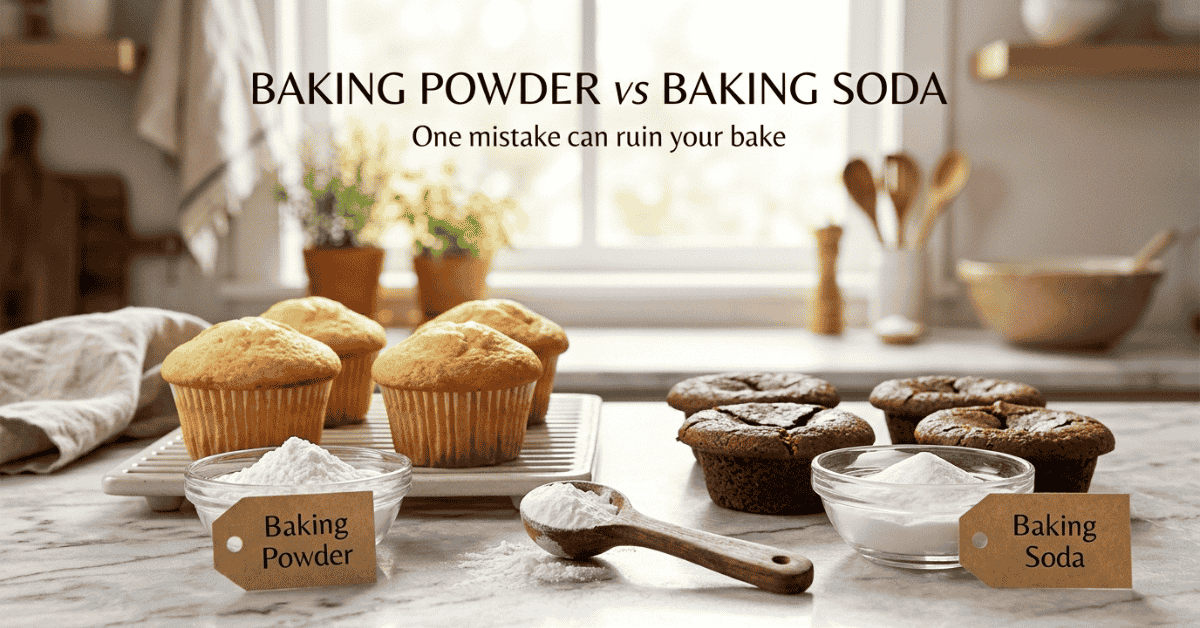
I still remember the first time I confidently swapped baking soda for baking powder in a banana bread recipe. The result? A dense, slightly metallic-tasting loaf that I quietly threw away before anyone could see it. And I was already a trained pastry chef at that point. That’s how sneaky these two white powders are — they look identical, they both make things rise, and yet they are fundamentally different in ways that completely change the outcome of your bake.
If you’ve ever had a cake that came out flat, a muffin that tasted bitter, or a bread that just felt heavy and sad, there’s a real chance this confusion was behind it. Let me break it down for you in the simplest way possible — no complicated chemistry, just what you actually need to know to bake better.
What Even Is Baking Soda?
Baking soda is pure sodium bicarbonate. That’s it. Nothing else inside that box. It’s a base — meaning it’s alkaline in nature — and on its own, it does absolutely nothing. It just sits there.
The moment baking soda comes in contact with something acidic — buttermilk, yogurt, lemon juice, vinegar, brown sugar, honey, cocoa powder, or even ripe bananas — a chemical reaction fires off instantly. Carbon dioxide gas is released, and that’s what creates the rise in your bake. The bubbles form, the batter expands, and you get that light, airy texture.
Here’s what most people miss though: because this reaction happens the second the wet and dry ingredients meet, you cannot mix the batter and then leave it sitting on the counter while you preheat the oven. By the time your oven is ready, most of the lift is already gone. Baking soda batters need to go straight in.
Baking soda is also about 3 to 4 times more powerful than baking powder. Using too much of it doesn’t just give you extra lift — it leaves behind a soapy, bitter aftertaste that lingers in a very unpleasant way. And it can also turn certain batters a strange yellowish-green colour (this is especially noticeable in red velvet cake if you get the balance wrong).
What Is Baking Powder Then?
Baking powder is essentially baking soda that’s been made more convenient. It contains sodium bicarbonate, but it also has a dry acid (usually cream of tartar or sodium aluminum sulfate) and a starch — typically corn starch — which absorbs moisture and keeps the two from reacting prematurely inside the tin.
Because the acid is already built in, baking powder doesn’t need an acidic ingredient in the recipe to do its job. It can work in a plain milk-based cake, a vanilla sponge, or anything that doesn’t carry natural acidity.
Most baking powders available today are double-acting — meaning they release gas twice. Once when they come in contact with moisture (when you mix your batter), and a second time when exposed to heat (when the batter goes into the oven). This two-stage action is incredibly useful because it gives your bakes a second burst of lift even after sitting.
This is why most standard cake recipes use baking powder — it’s more forgiving, and the batter can wait a few minutes without losing all its rise.
The Real Difference That Changes Everything
Let me put it plainly. The choice between these two isn’t about which one is “stronger” or “better.” It’s about matching the leavener to what’s in your recipe.
If your recipe has buttermilk, curd, lemon juice, vinegar, or natural cocoa powder — it has acid. That acid needs baking soda to react with, and that’s exactly what you should use. If you use baking powder here instead, the acid in your recipe goes unmatched, the flavour turns slightly sharp or sour, and the lift is weaker than it should be.
If your recipe uses regular milk, cream, butter, or other neutral ingredients without any acid source — baking powder is your go-to. There’s no acid in the batter to activate plain baking soda, so it would just sit there doing nothing, and your bake would be flat.
Here’s where it gets interesting: many professional recipes use both. Why? Because sometimes a recipe needs both more lift and a flavour balance. Take chocolate cake as an example. You might have natural cocoa powder (acidic) in there, which reacts with baking soda — but you also want additional rise that baking powder provides. The baking soda neutralises the acidity and deepens the chocolate flavour, while the baking powder handles the structural lift. Together, they do something neither can do alone.
What Happens When You Use the Wrong One?
Using only baking soda in a recipe that calls for baking powder: your cake will rise too fast and then collapse, and it’ll taste bitter or soapy — especially if you’ve used too much trying to compensate.
Using only baking powder in a recipe that calls for baking soda: you’ll get less rise, a denser crumb, and the flavour won’t be right. The acidity in your recipe won’t be neutralised properly.
Using too much of either: over-leavened batters rise aggressively and then fall flat. The texture gets coarse and open. With baking soda especially, too much leaves a metallic taste and sometimes an unpleasant smell while baking.
Using too little: flat, dense, compact bakes. No surprises there.
A Few Things Nobody Tells You
Freshness matters more than people think. Both baking soda and baking powder lose their potency over time, especially once opened. If your tin has been sitting in the back of your kitchen drawer for a year and a half, it’s probably past its useful life. To test baking soda, drop a little into hot water with a splash of vinegar — it should bubble immediately and vigorously. To test baking powder, drop a teaspoon into hot water — it should foam right away without any added acid.
Altitude changes the game. If you’re baking at a higher altitude (which affects parts of India like hill stations), leavening agents work more aggressively because air pressure is lower. You typically need to reduce the amount slightly, or your bakes will over-rise and collapse.
Storage is simple but important. Keep both in a cool, dry place, away from steam. Your jar near the stove or right beside the sink is the worst spot. Moisture activates them slowly over time, and by the time you actually need them, they’ve lost their power.
In eggless baking, this matters even more. Eggs in a traditional recipe naturally help with structure and lift. When you’re baking eggless — which is something I work with a lot in my courses — the leavening agents carry a bigger load. Getting the proportions right is not optional; it’s the difference between a cake that holds up and one that collapses the moment it cools.
A Simple Rule to Carry With You
Whenever you look at a recipe, scan the ingredients for anything acidic. Curd? Buttermilk? Lemon? Vinegar? Honey? Brown sugar? Natural (not Dutch-processed) cocoa? If yes, baking soda is there for a reason. If the recipe is neutral and mild, baking powder is doing the work. And when you see both, trust that they’re each handling a different part of the job.
Baking is not guesswork — and understanding why each ingredient is in a recipe is what separates someone who follows instructions from someone who actually knows how to bake. Once you understand these two little powders properly, you’ll find that a lot of “mystery failures” in your kitchen suddenly make perfect sense.
Chef Minali Zaveri is a Mumbai-based pastry chef trained at Ferrandi Paris, with over 10 years of professional baking experience. She teaches eggless baking, healthy baking, and professional pastry techniques through her online masterclasses at The Crème Company.